The Trauma Link
The Connection Between Trauma and Self-Harm
How traumatic experience can drive self-harm, and why treating the trauma matters
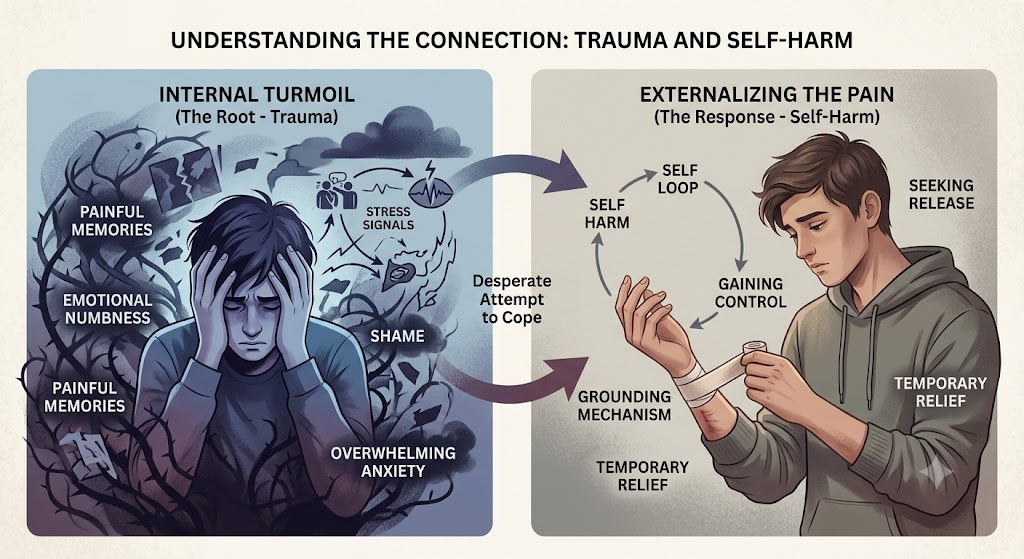
The link between trauma and self-harm is one of the most well-documented relationships in adolescent mental health. Studies consistently find that teens who self-harm report significantly higher rates of adverse childhood experiences, with one study finding that over 70% of adolescents struggling with self-harm also reported childhood abuse. Trauma does not cause self-harm in a simple, direct line. Instead, it creates the emotional conditions — numbness, shame, loss of control, and emotional dysregulation — that make self-harm feel necessary.
Understanding how trauma produces self-harm helps parents see past the surface behavior to the wound underneath. The self-harm is not the problem. It is the teen's attempt to manage a problem that has never been addressed.
What Counts as Trauma for a Teenager
Parents sometimes hesitate to use the word "trauma" because they associate it with extreme events — combat, natural disasters, or severe physical abuse. But trauma is defined by its impact on the individual, not by the event itself. For adolescents, traumatic experiences can include:
- Physical, sexual, or emotional abuse
- Emotional neglect — growing up in an environment where feelings were dismissed, minimized, or punished
- Witnessing domestic violence or parental conflict
- Bullying — especially sustained social exclusion, cyberbullying, or physical intimidation
- A parent's addiction, mental illness, or incarceration
- Divorce or family disruption that left the teen feeling unsafe
- Medical procedures, chronic illness, or hospitalization
- The sudden loss of a relationship, a friend, or a family member
- Sexual assault or coercion
- Community violence or living in an environment of chronic threat
The common thread is not the severity of the event but the teen's experience of it: did it overwhelm their capacity to cope? Did it compromise their sense of safety? Did it leave them with emotional pain they could not process? If the answer to any of these is yes, the experience may be functioning as trauma — regardless of how it might appear from the outside.
Three Pathways From Trauma to Self-Harm
Trauma leads to self-harm through several interconnected mechanisms. Understanding these pathways helps parents recognize when trauma may be the driver and helps clinicians match the right treatment.
Pathway 1: Numbness and disconnection
Trauma can cause the brain to shut down emotional processing as a protective measure. The teen stops feeling — not by choice, but because their nervous system has learned that emotions are too dangerous to experience fully. This emotional numbness can extend to feeling disconnected from their body, from other people, and from reality itself. Clinicians call this dissociation.
Self-harm breaks through the numbness. Physical pain forces the brain to register sensation and emotion, pulling the teen back into their body. For a teen trapped in dissociative numbness, the pain of self-injury feels better than the void — because at least they feel something.
What parents may notice: A teen who seems emotionally flat, detached, or "not really there." They may describe feeling like they are watching their life from outside, that nothing feels real, or that they feel nothing at all. The self-harm may occur during these flat, disconnected periods rather than during obvious emotional distress.
Pathway 2: Shame and self-punishment
Trauma — especially abuse, neglect, and emotional invalidation — can leave teens with a deep, internalized belief that they are fundamentally broken, worthless, or deserving of pain. This shame is not about what happened to them; it is about what they have come to believe about themselves because of what happened. Self-harm then becomes a form of self-punishment that feels consistent with their self-concept: "I am bad, so I deserve to hurt."
This pathway is particularly common in teens who experienced emotional abuse (being told they are stupid, worthless, or unwanted) or sexual abuse (where shame and self-blame are pervasive). The self-harm validates the internal narrative of worthlessness, which is why it can be so resistant to change without therapeutic work on the underlying beliefs.
What parents may notice: Intense self-criticism, expressions of worthlessness or self-hatred, and self-harm that follows perceived failures or mistakes. The teen may say things like "I deserve this" or "I'm a terrible person." The self-harm often occurs after situations where the teen feels they have confirmed their own worst beliefs about themselves.
Pathway 3: Restoring control over one's own body
Trauma that involves violation of bodily autonomy — physical abuse, sexual assault, invasive medical procedures, or environments where the teen had no control over what happened to their body — can lead to self-harm as a reassertion of agency. The teen is reclaiming ownership of their body by being the one who decides what happens to it. The self-harm says: "This body is mine, and I decide what happens to it now."
This pathway may also activate in teens who feel controlled in other ways — a rigidly authoritarian home, a parent's addiction that makes the household unpredictable, or any situation where the teen's sense of agency has been systematically undermined.
What parents may notice: Intense protectiveness over privacy and bodily autonomy. Self-harm that intensifies during periods when the teen feels their control is being taken away. Resistance to any intervention that feels imposed rather than collaborative. The secrecy surrounding the self-harm may itself be part of the control dynamic.
Why Treating the Self-Harm Without Treating the Trauma Doesn't Work
This is the most important message on this page. When trauma is driving the self-harm, coping skills and behavioral interventions alone — no matter how well-designed — can only manage the symptoms. The self-harm will continue to recur because the emotional pain generating it has not been addressed.
Treatment for trauma-driven self-harm typically involves two parallel tracks: immediate safety (DBT skills, safety planning, means reduction) and trauma processing (TF-CBT or another trauma-focused approach that helps the teen process the experiences and beliefs driving the behavior). Most clinicians stabilize the self-harm first, then gradually introduce trauma processing as the teen builds enough coping capacity to tolerate the work.
This dual-track approach is why the treatment timeline for trauma-driven self-harm is often longer than for self-harm without a trauma history. The teen is doing two kinds of work simultaneously: learning to manage the urges and healing the wound that generates them. Both are necessary. Neither alone is sufficient.
How Trauma-Focused Therapy Helps
Trauma-Focused CBT (TF-CBT) is the most evidence-based approach for treating trauma in adolescents. It helps teens process the traumatic experience in a safe, structured environment, challenge the shame-based beliefs the trauma created ("It was my fault," "I am damaged," "I deserved it"), develop a coherent narrative about what happened, and rebuild a sense of safety and agency.
As the trauma is processed, the emotional conditions that drive self-harm — the numbness, the shame, the loss of control — gradually decrease. The self-harm becomes less necessary because the pain it was managing has been addressed at its source.
For teens who need both trauma processing and immediate self-harm management, a combination of TF-CBT and DBT skills is often the most effective approach.
The self-harm is not the problem. It is the teen's attempt to manage a problem that has never been addressed. Treating the trauma is how you treat the cause.
Sources: National Child Traumatic Stress Network — complex trauma effects; PMC — NSSI and childhood abuse (71.3%); Cohen, Mannarino, Deblinger — TF-CBT evidence base; NICE guidance on self-harm and trauma.